blog
Beyond the World Cup: The Financing Engine Powering the World's Biggest Sport
David Vatchev, Head of Tokenization
16 July 2026

The views expressed in this article are those of Fasanara Capital Ltd as at the date of publication and are provided for general information purposes only. They should not be regarded as investment advice.

For supporters, football is emotion, identity and community.
For clubs, it is also a business of working capital, contracted revenues and continuous investment. The modern game depends on a financial system almost as international and interconnected as the sport itself.
That system is rarely visible to the people filling stadiums. Yet it influences the players clubs can acquire, the facilities they can build and how quickly sporting success can be turned into long-term growth.
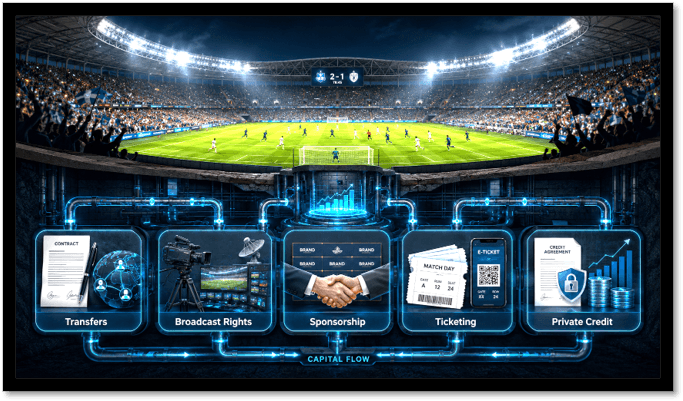
Football has become a global economy
Data from Twocircles, shows global sports revenues surpassed $170 billion in 2024, reflecting the convergence of sport, media, technology and entertainment. Within this growing industry, football remains the largest and most international commercial platform.
European football generated a record €38 billion in revenue in 2023/24, up 8% year-on-year. The five largest European leagues contributed more than €20 billion, while the Premier League alone generated £6.3 billion.
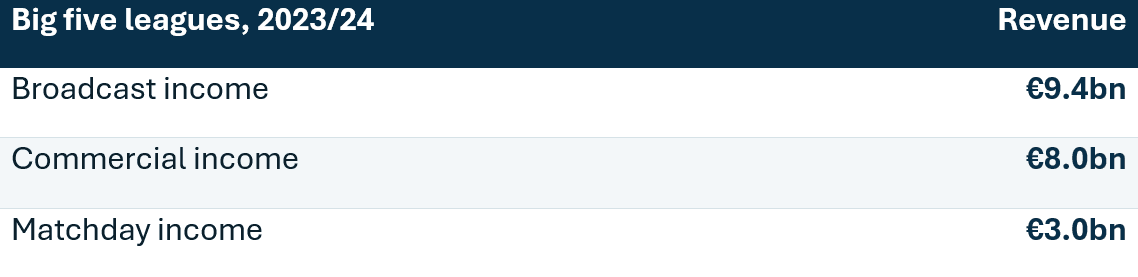
Source: Deloitte, Annual Review of Football Finance 2025, Fasanara Capital.
Every goal begins with capital
A football club can have a globally recognised brand, valuable players and substantial future income, while still facing limited liquidity today. The reason is timing. Broadcasting and sponsorship payments arrive according to agreed schedules. Stadium projects require investment before generating revenue. Player transfers are frequently paid over several years.
A club may therefore have the economic resources to invest, but not have the cash available at the exact moment it is needed. This is a familiar problem across the real economy. Companies finance invoices, equipment and future contractual payments. Football clubs increasingly do the same. The difference is that football involves unusual assets, specialist regulation and highly time-sensitive transactions. These features can make conventional financing difficult, but they also create an opportunity for lenders that understand the sector.
The financial story inside every transfer
When a player is sold for €60 million, the selling club may not receive €60 million immediately. The buying club might pay an initial amount, followed by instalments over the next two or three years. The seller therefore receives a contractual claim on future payments. In financial terms, that claim is a receivable.
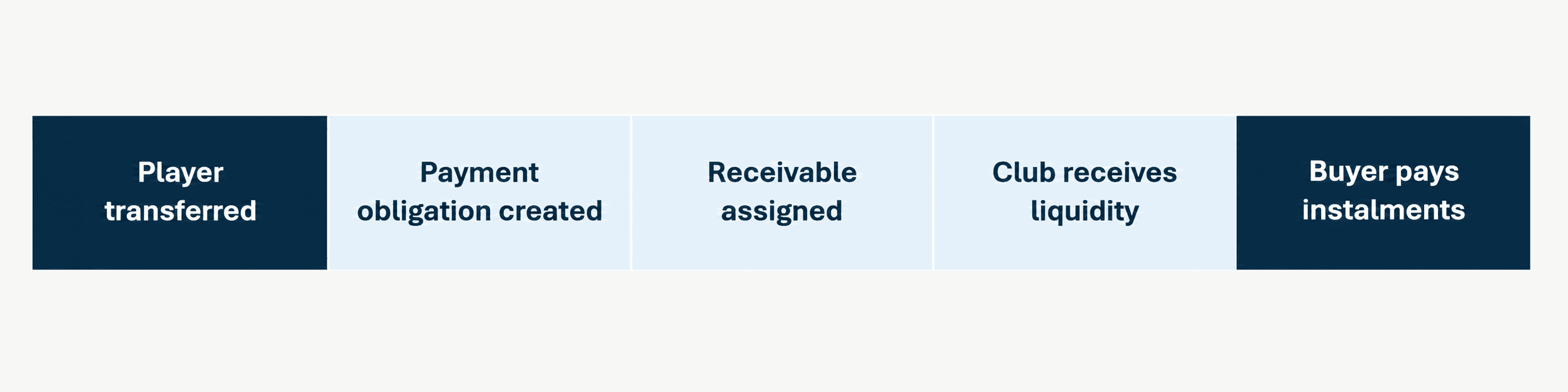
This allows the selling club to reinvest without waiting years for the full transfer fee.

Crucially, repayment is not intended to depend on whether the transferred player goes on to score goals. It depends primarily on whether the buying club meets its contractual obligations.
Football's regulatory environment can support payment discipline. UEFA and domestic leagues monitor transfer obligations, and non-payment can result in fines, transfer restrictions, points deductions or other sanctions. This does not remove credit risk, but it creates an unusual degree of oversight around the underlying payments.
Beyond transfers
Sports financing is not one single product, and Fasanara has identified three broad areas within a potential annual financing market exceeding €4 billion:

Squad-backed financing addresses the period before a player is sold. A facility can be structured around the overall value and future transfer potential of a playing squad, with future receivables assigned to the lender when transfers occur. Other facilities may be supported by broadcasting income, sponsorship contracts, ticketing flows or stadium-related revenues.
Stadiums are becoming year-round infrastructure
Modern stadiums are increasingly designed as commercial destinations operating throughout the year. Hospitality, retail, museums, concerts and corporate events can turn a venue from a matchday asset into revenue-producing infrastructure. Real Madrid provides the clearest example. Its redeveloped Bernabeu helped lift club revenues above €1 billion, supported by a strategy to use the venue as a year-round entertainment platform.
The shift matters because it changes the nature of borrowing. Capital is increasingly being used not merely to bridge operational losses, but to fund tangible assets and new sources of recurring revenue.
What allocators are really underwriting
For allocators, the key question is not who wins on the pitch, but which cash flows support repayment.
A sports-credit transaction may be linked to a documented transfer payment, a sponsorship contract, broadcasting income or another identifiable revenue stream. This creates a different risk profile from buying shares in a club or making a speculative investment in its future valuation.
The lender must establish that the asset exists, that it can be legally assigned, that cash is directed through controlled accounts and that the same collateral has not been pledged elsewhere.
This reflects a wider principle across asset-based finance. The quality of a transaction depends not simply on what appears to support it, but on how that asset and its cash flows are controlled throughout the life of the loan.
Beyond the final whistle
The World Cup shows football at its most visible.
The financing engine behind it is far less visible, but no less important. Every transfer creates a series of payments. Every stadium requires capital before it produces returns. Every club must manage the distance between future ambition and available cash.
For supporters, this provides a different perspective on what happens beyond the pitch.
For institutional market participants, it illustrates how specialist private credit structures are being applied to particular areas of the real economy through contractual revenues and asset-level structures. Football's financing engine keeps running all year.
About Fasanara
Fasanara has developed direct domain expertise in sports lending through F-Sports, applying its broader asset-based finance capabilities to player-transfer receivables, squad-backed facilities and other contracted sports revenues. The opportunity reflects a wider Fasanara principle: specialist knowledge and disciplined structuring can unlock parts of the real economy that traditional finance often struggles to serve.
- Fasanara Sports provides the dedicated origination and underwriting ecosystem for football and wider sports-related financing.
- The Fasanara Ferrari Lending Platform extends the same specialist approach into the sports and collector-car economy, financing highly valuable Ferrari collections and race cars through a partnership with Enzo Mattioli Ferrari and Giacomo Mattioli.
- These differentiated opportunities can ultimately be brought together within Fasanara One, Fasanara’s flagship multi-platform origination, which today counts over 200 independent pods of lending/trading, with specialist knowledge, proprietary origination and collateral control create a genuine competitive edge and proprietary tech.
This is the first article in Fasanara’s Capital Behind Performance series, exploring the specialist financing behind sport, iconic brands and other consumer-facing industries.
Disclaimer
This material is not intended to be a recommendation or investment advice, does not constitute a solicitation to buy, sell, or hold a security or an investment strategy, and is not provided in a fiduciary capacity. The information provided does not take into account the specific objectives or circumstances of any particular investors or suggest any specific course of action. Investment decisions should be made based on an investor’s objectives and circumstances and in consultation with their financial professionals. The views and opinions expressed are for informational and educational purposes only as of the date of production/writing and may change without notice at any time based on numerous factors, such as market or other conditions, legal and regulatory developments, additional risks and uncertainties and may not come to pass. This material may contain “forward-looking” information that is not purely historical in nature. Such information may include, among other things, projections, forecasts, estimates of market returns, and proposed or expected portfolio composition. Any changes to assumptions that may have been made in preparing this material could have a material impact on the information presented herein by way of example. Past performance does not predict or guarantee future results. Investing involves risk; principal loss is possible. All information has been obtained from sources believed to be reliable, but its accuracy is not guaranteed. There is no representation or warranty as to the current accuracy, reliability or completeness of, nor liability for, decisions based on such information and it should not be relied on as such. Fasanara Capital Ltd, is authorised and regulated by the Financial Conduct Authority (“FCA”).
Important information on risk
Investing involves risk. The value of any investment and the income from such can go down as well as up, and you may not get back the full amount invested. Changes in the rate of exchange may also cause the value of overseas investments to go up or down. This information represents the views of Fasanara Capital Ltd and its investment specialists. It is not intended to be a forecast of future events and/or guarantee of any future result. Information was obtained from third party sources which we believe to be reliable but are not guaranteed as to their accuracy or completeness. There is no assurance that an investment will provide positive performance over any period of time. This information does not constitute investment research as defined under MiFID.