blog
Higher for Longer: Why Short-Duration Credit Behaves Differently
David Vatchev, Head of Tokenization
13 October 2026

The views expressed in this article are those of Fasanara Capital Ltd as at the date of publication and are provided for general information purposes only. They should not be regarded as investment advice.
For credit investors, the important question is not simply where rates go next, but how their investments behave when they move.
Higher rates are not one trade
For much of the past two years, markets debated how quickly central banks would cut rates. That assumption is being tested.
Between 10 and 18 September 2026, the European Central Bank and the Federal Reserve each raised policy rates by 25 basis points, and the Bank of Japan lifted its policy rate to its highest level since 1995. The Bank of England held, but three of its nine policymakers voted for an increase. For much of the past two years, markets debated how quickly central banks would cut. That debate has turned: inflation, geopolitical shocks and resilient economic activity have reintroduced two-way risk into the global rate cycle.
For credit investors, that revives a familiar question: what does a higher and less predictable rate environment actually mean for private credit? The conventional answer focuses on the borrower. Higher rates increase debt-service costs, reduce interest coverage and make refinancing more difficult. But that is only part of the story.
Private credit does not respond to higher rates in one uniform way. A five-year corporate loan reliant on future refinancing carries rate risk very differently from a portfolio of short-dated receivables that continuously amortises and creates recurring opportunities to redeploy capital. What matters is how quickly capital comes back, whether repayment depends on refinancing, and how often the lender gets the chance to reassess the risk.
That is where short-duration asset-backed finance starts to behave differently, and that distinction is central to Fasanara's approach.
The objective is not to make a directional bet on rates. It is to finance identifiable real-economy cash flows through short-dated assets that repay and can be underwritten again as conditions change.
The duration is in the cash flow, not just the coupon
Traditional corporate credit can remain exposed to the same borrower for several years. Even when the coupon floats, the underlying credit exposure does not reset. If rates rise, the borrower pays more interest. If spreads widen, the existing loan does not automatically become a better credit. And when maturity approaches, repayment may depend on another lender being willing to refinance it.
Short-duration receivables behave differently. An invoice that matures in a few months does not require an investor to make a five-year view on rates, enterprise value or refinancing conditions. The asset pays down, capital comes back and the portfolio gets another opportunity to decide where - and at what price - to deploy it.
Short duration therefore does more than reduce rate sensitivity. It creates optionality. As assets mature and capital returns, managers have repeated opportunities to reassess pricing, underwriting standards and portfolio allocation against the prevailing opportunity set. That allows the portfolio to adjust over time rather than remain tied to an earlier vintage.
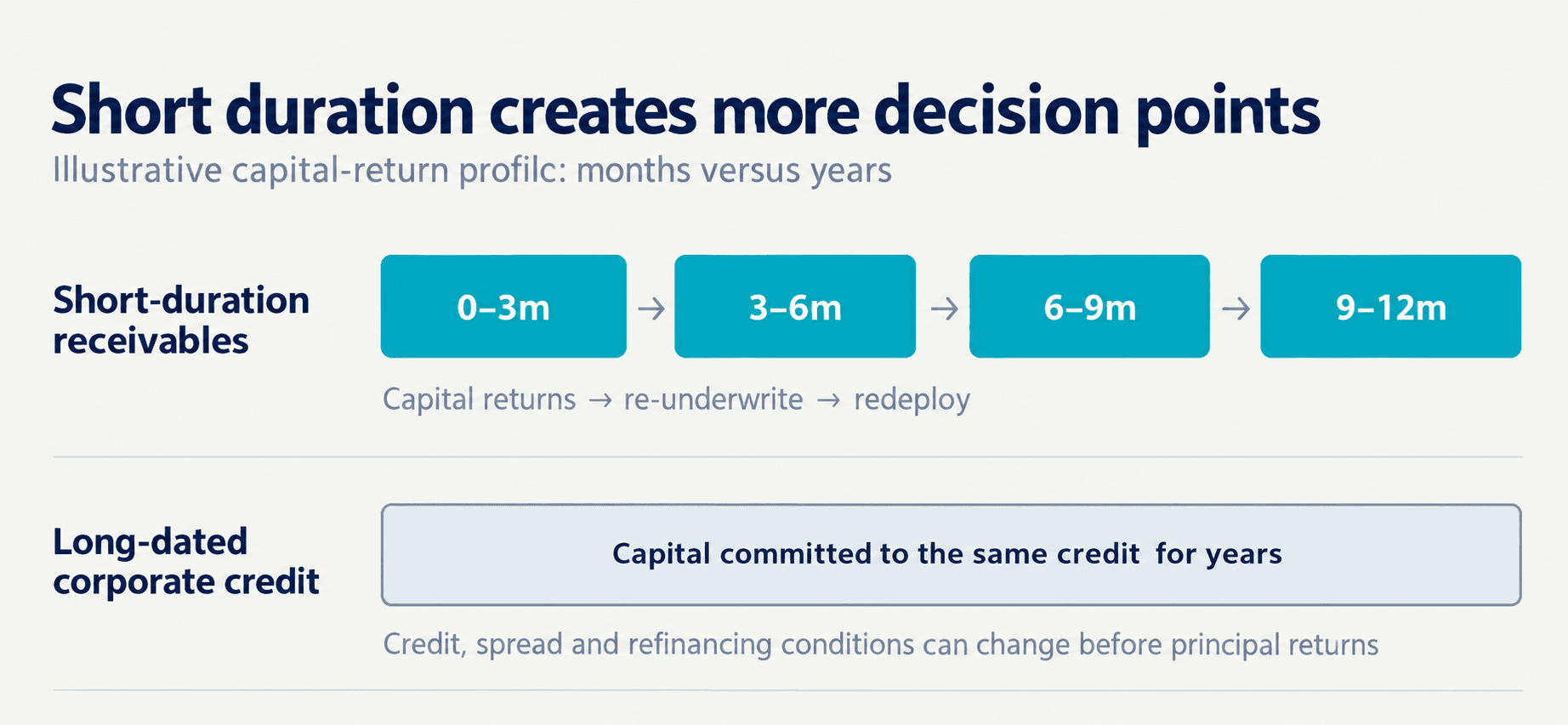
Figure 1: Short-dated receivables can return capital in months, allowing pricing, underwriting, and allocation to be revisited repeatedly. Longer-dated corporate credit can commit capital to the same borrower for years.
Short duration creates repricing optionality
Higher rates are not automatically positive for an asset-backed strategy. Cash itself becomes more competitive, the hurdle rate rises and investors should demand appropriate compensation for taking credit risk. In an environment of strong growth, benign inflation and resilient corporate fundamentals, liquid fixed income can offer more yield without necessarily taking materially more risk.
The picture changes when higher rates come with inflation, geopolitical shocks or tighter financial conditions. Long-duration assets carry yesterday's underwriting into tomorrow's economy. Short-duration assets keep returning capital.
As those assets mature, capital comes back and can be redeployed into new opportunities on newly agreed terms. That allows pricing and credit quality to adjust over time without having to sell large parts of the existing portfolio. The distinction is simple: short duration creates more opportunities to reprice and reassess; it does not mean repricing happens automatically.
In practice, the economics of new assets are negotiated with originators and counterparties rather than mechanically linked to base rates.
Portfolio yields need not move in lockstep with policy rates. Short duration instead provides recurring opportunities for the portfolio to adapt as assets mature and new opportunities are underwritten. This is consistent with a broader Fasanara principle: returns should come from identifiable economic activity and disciplined underwriting, not from needing a market forecast to be right.
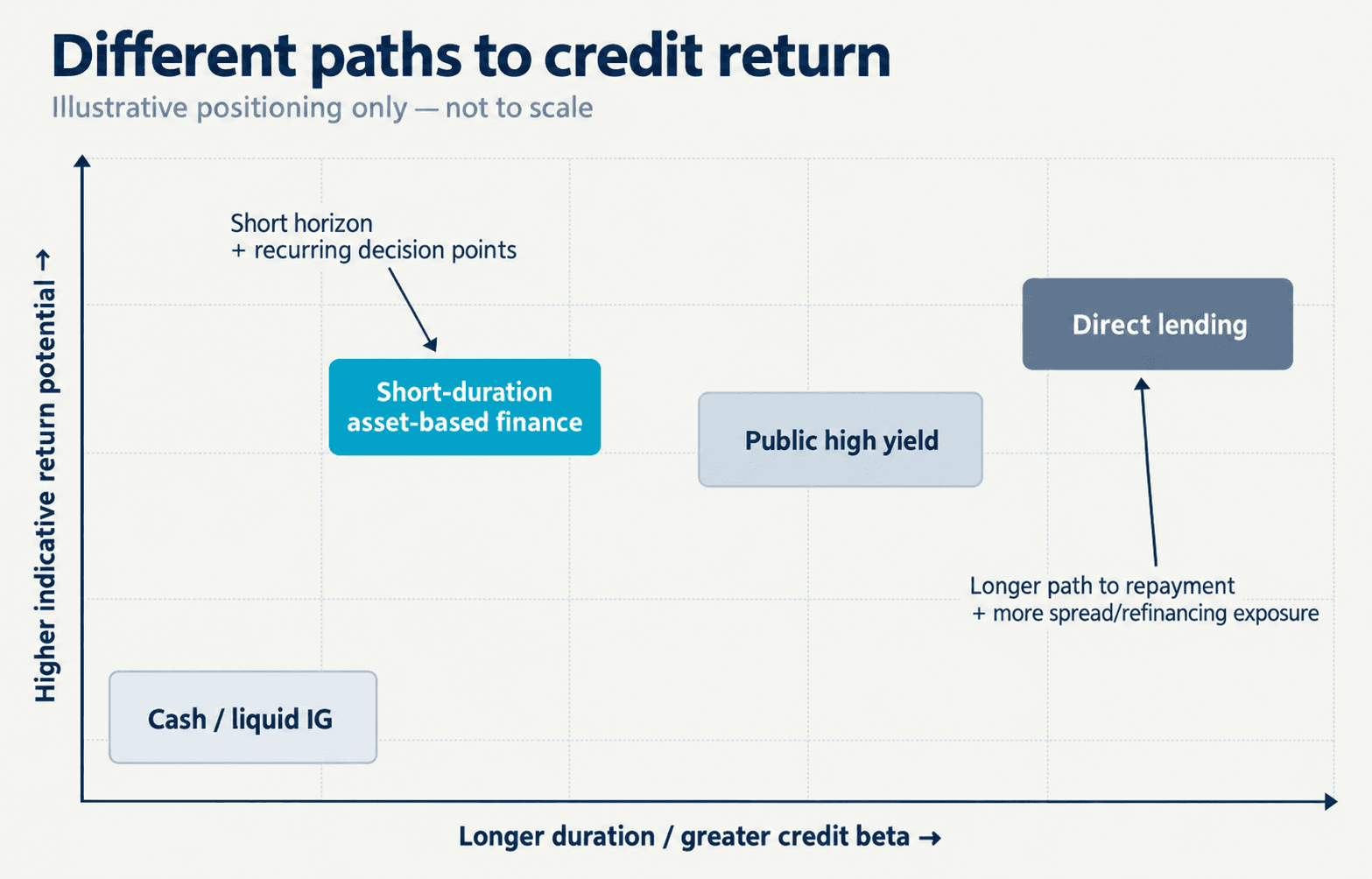
Figure 2: Illustrative positioning of selected credit segments by return potential and duration / credit beta. Headline yield is only one part of prospective return; credit spread, duration, credit quality and refinancing exposure determine how that yield is ultimately realised.
Spread matters as much as headline yield
Headline yield is only one part of prospective return. It matters how much of that yield comes from the risk-free rate, how much comes from credit spread, and how long the investor must remain exposed to earn it.
In a higher-rate environment, long-dated high-yield bonds and private loans can offer attractive all-in yields even when credit spreads themselves are comparatively tight. The investor still bears years of credit migration, spread volatility and, in many cases, refinancing risk. For long-dated assets, today's yield can therefore be a poor guide to near-term realised return: the path between purchase and repayment matters.
Short-duration asset-backed finance works differently. A meaningful credit spread provides compensation for expected losses, while limited spread duration reduces sensitivity to changes in market pricing. Natural amortisation matters too: principal is continually returned, so the portfolio does not necessarily need spreads to tighten again before capital can be recycled.
Higher rates test the borrower differently
In corporate direct lending, higher rates can transmit directly into borrower interest expense. A business may remain operationally sound while a leveraged capital structure becomes progressively harder to service. Refinancing then becomes part of the investment thesis whether the lender intended it or not.
Asset-backed receivables introduce a different source of repayment. In asset-backed receivables, repayment comes from many short-dated contractual payment obligations arising from goods or services that have already been delivered. Credit risk remains - obligors can default, collections can weaken and recoveries can disappoint - but the return driver is less dependent on future EBITDA growth or on refinancing a leveraged enterprise several years from now.
Time horizon also changes what needs to be underwritten. Over a multi-year horizon, enterprise value, leverage, earnings growth and refinancing capacity become increasingly important. Over a much shorter period, near-term liquidity, collections and payment behaviour can tell the lender more about immediate credit performance. Corporate fundamentals and credit ratings still matter. The difference is that those assumptions do not need to hold for several years.
That distinction becomes more valuable when macro visibility falls. The real question becomes, what ultimately pays the lender, how that cash is controlled and how quickly new information about the underlying credit becomes visible. Frequent collections data and regular fair-value monitoring can provide a shorter feedback loop than a credit whose true stress may only become apparent at refinancing or maturity.
Structural protection and yield optionality
Resilience should not be confused with the absence of underlying credit events. Defaults and delinquencies can rise in stressed environments. What matters is how much of that deterioration ultimately reaches portfolio returns.
Diversification, first-loss protection, credit insurance and other structural enhancements can absorb part of that deterioration before it reaches portfolio returns. The relevant question is therefore not whether every underlying exposure performs perfectly, but whether the portfolio has sufficient margin for error when some do not.
There is another advantage to rapid portfolio turnover. The opportunity is not only to seek better economics. As capital returns, it can be redirected toward better risk-adjusted opportunities.
A portfolio that turns over continuously can adjust eligibility criteria, advance rates, sector exposure and counterparty quality as conditions evolve. During periods of wider spreads, that can create opportunities to improve portfolio quality while preserving attractive return potential - but only where suitable assets are available at terms that still justify the risk.
In stressed periods, preserving credit quality can matter more than capturing every extra basis point of yield. Short duration creates the flexibility to tighten underwriting, rotate exposures or hold back capital rather than accept a weaker credit mix simply to maintain yield.
For a long-duration portfolio, changing the average risk profile may require selling assets or waiting years for maturities. For short-duration credit, more of that adjustment can take place through the normal reinvestment cycle. Volatility can improve the opportunity set, but only where the additional return adequately compensates for the additional risk.
Portfolio construction matters more than the rate call
Markets will continue debating whether the next move is another hike or an eventual return to easing. For short-duration asset-backed credit, that forecast is less important than it may first appear.
The objective is not to predict rates perfectly.** It is to construct a portfolio that can adapt when the prediction is wrong**. Short duration creates more decision points; diversification creates more choices about where returned capital can be deployed.
Higher rates have an opportunity cost: cash yields more, financing costs rise and investors should demand appropriate compensation for taking credit risk. But higher rates also expose the structural differences inside private credit. Strategies reliant on leveraged borrowers, long holding periods and eventual refinancing carry one type of rate risk. Strategies built around short-duration, naturally amortising assets carry another.
Fasanara's experience across negative rates, the pandemic, the 2022 inflation shock and the subsequent normalisation of European interest rates illustrates that distinction. The investment process has relied on short-dated underlying assets, active redeployment and diversification rather than a directional duration trade.
For short-duration credit, the ability to get capital back, reassess the risk and lend again may be one of the most valuable forms of protection a changing rate environment can offer.
Disclaimer
This material is not intended to be a recommendation or investment advice, does not constitute a solicitation to buy, sell, or hold a security or an investment strategy, and is not provided in a fiduciary capacity. The information provided does not take into account the specific objectives or circumstances of any particular investors or suggest any specific course of action. Investment decisions should be made based on an investor’s objectives and circumstances and in consultation with their financial professionals. The views and opinions expressed are for informational and educational purposes only as of the date of production/writing and may change without notice at any time based on numerous factors, such as market or other conditions, legal and regulatory developments, additional risks and uncertainties and may not come to pass. This material may contain “forward-looking” information that is not purely historical in nature. Such information may include, among other things, projections, forecasts, estimates of market returns, and proposed or expected portfolio composition. Any changes to assumptions that may have been made in preparing this material could have a material impact on the information presented herein by way of example. Past performance does not predict or guarantee future results. Investing involves risk; principal loss is possible. All information has been obtained from sources believed to be reliable, but its accuracy is not guaranteed. There is no representation or warranty as to the current accuracy, reliability or completeness of, nor liability for, decisions based on such information and it should not be relied on as such. Fasanara Capital Ltd, is authorised and regulated by the Financial Conduct Authority (“FCA”).
Important information on risk
Investing involves risk. The value of any investment and the income from such can go down as well as up, and you may not get back the full amount invested. Changes in the rate of exchange may also cause the value of overseas investments to go up or down. This information represents the views of Fasanara Capital Ltd and its investment specialists. It is not intended to be a forecast of future events and/or guarantee of any future result. Information was obtained from third party sources which we believe to be reliable but are not guaranteed as to their accuracy or completeness. There is no assurance that an investment will provide positive performance over any period of time. This information does not constitute investment research as defined under MiFID.