blog
The Market Is The Margin Loan.
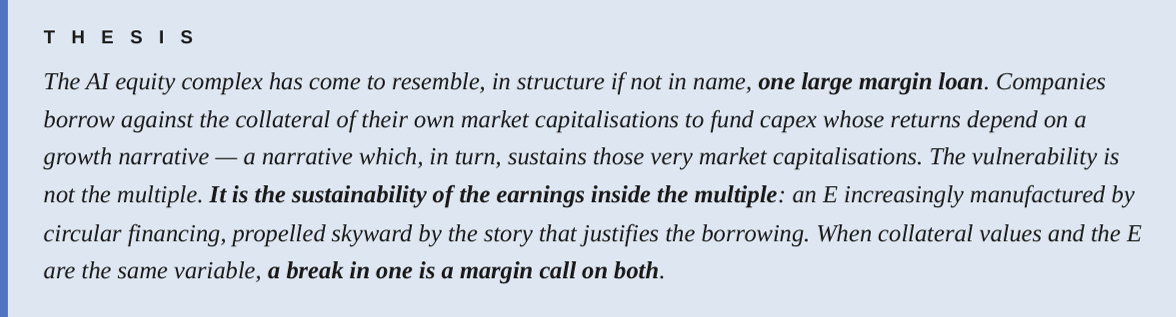
Equity-financed narratives of permanent growth have turned pristine balance sheets into leveraged bets on their own share prices. The question is not the P. It is the E.
Francesco Filia, Founder and CEO
17 July 2026
Download a PDF version of this insight here.
Equity-based financing of permanent growth narratives
There is a dangerous misconception in today's equity markets. Investors spend endless hours debating valuation: is the P/E too high, should multiples be 25x or 35x, is AI in a bubble. These are the wrong questions. The real question is far more fundamental: what happens when the equity itself becomes the financing mechanism?
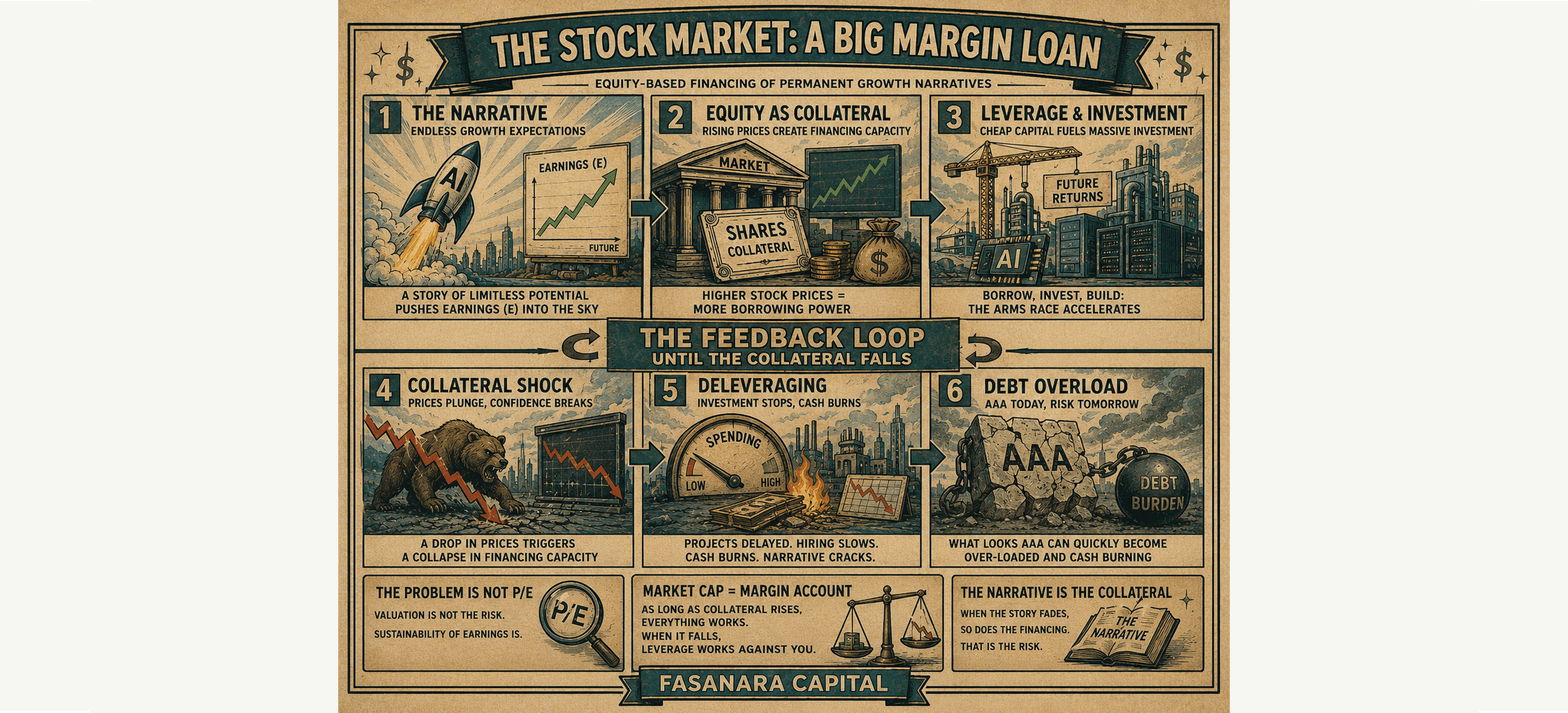
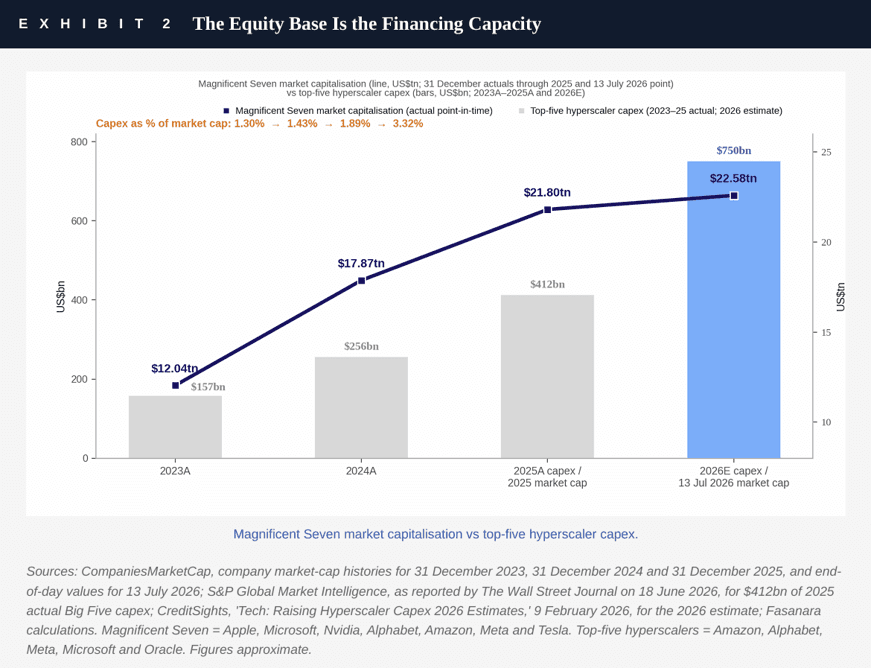
Traditionally, companies generated earnings first and financed growth second. Today, increasingly, the opposite happens. High equity prices allow companies to raise enormous amounts of capital at extremely low cost. Those proceeds finance acquisitions, infrastructure, hiring, R&D and expansion. The investments are expected to generate future earnings, which in turn justify even higher valuations. Higher valuations create even cheaper financing. The cycle repeats. The equity market starts functioning less like a marketplace and more like one giant margin loan, and the collateral is the company's own share price.
This is particularly visible in AI. The largest technology companies are committing hundreds of billions of dollars to data centres, chips, energy infrastructure and software ecosystems. Many of these investments may ultimately prove enormously valuable. That is not the point. The point is that the financing assumptions increasingly depend upon today's market capitalisation remaining elevated. If the collateral remains strong, capital remains virtually unlimited. If the collateral weakens, the economics change immediately.
This is exactly how margin lending works. As long as collateral appreciates, leverage appears harmless. Borrowers refinance, credit expands, confidence increases; everything looks stable. Until collateral declines. Then the process reverses: financing becomes more expensive, projects are delayed, hiring slows, capital expenditure contracts, confidence deteriorates, and the decline in collateral starts reinforcing itself.
Notice something important. The problem is not the P/E multiple; markets have survived expensive valuations many times. The real vulnerability lies elsewhere — in the denominator. Earnings. Specifically, the sustainability of the future earnings expectations embedded in current prices. Today's market is increasingly pricing not simply earnings growth, but the permanence of extraordinary earnings growth. The narrative assumes AI productivity gains will continue expanding almost indefinitely; every incremental investment is expected to generate even larger future cash flows; every dollar spent today is assumed to justify multiple dollars of market capitalisation tomorrow. That assumption deserves far more scrutiny than today's valuation multiple.
Narratives are extraordinarily powerful financial assets. Unlike factories or patents, however, narratives cannot be pledged directly. Instead, they are embedded inside equity prices. The higher the narrative, the higher the valuation; the higher the valuation, the greater the financing capacity. Eventually, narrative itself becomes collateral. That is where systemic fragility begins.
History offers many examples; railroads, telecommunications, the internet, housing. Each was built upon genuinely transformative innovation. Each ultimately changed the world. Yet investors still experienced periods where financing assumptions became detached from economic reality. The technology survived; many capital structures did not. AAA assets can deteriorate surprisingly quickly — not because the underlying technology suddenly stops working, but because financing conditions change. Companies that appear fortress-like can become heavy cash burners if capital expenditure remains enormous while expected returns are pushed further into the future. The transition from pristine balance sheet to heavily leveraged growth story can happen much faster than conventional credit analysis anticipates. The deterioration often starts with collateral. Not with default.

Credit investors have always understood that principle. When share prices themselves become the primary source of financing, the entire ecosystem starts behaving like a leveraged credit structure: everything works beautifully while collateral appreciates, and everything becomes fragile when it no longer does. Artificial intelligence may well become the most important technological revolution of our generation. That possibility is entirely compatible with another observation: markets can simultaneously be right about technology and wrong about financing. Those are two very different propositions. The first concerns innovation. The second concerns leverage. Investors often confuse them. History rarely does.
From fortress to financing vehicle
For the better part of two decades, the mega-cap technology balance sheet was the closest thing public markets had to a sovereign. Net cash positions. Leverage below one turn. Free cash flow so abundant it had to be returned, buybacks and dividends measured in the hundreds of billions. Credit investors barely needed to think about these names; equity investors never needed to think about their debt. There was an unspoken contract: speculative AI spending would be equity-funded and cash-funded, and the fortress would stay a fortress.
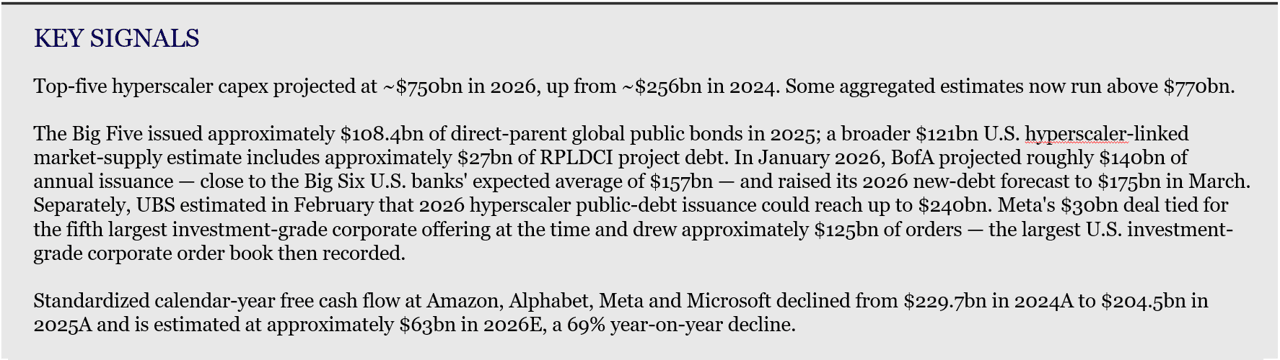
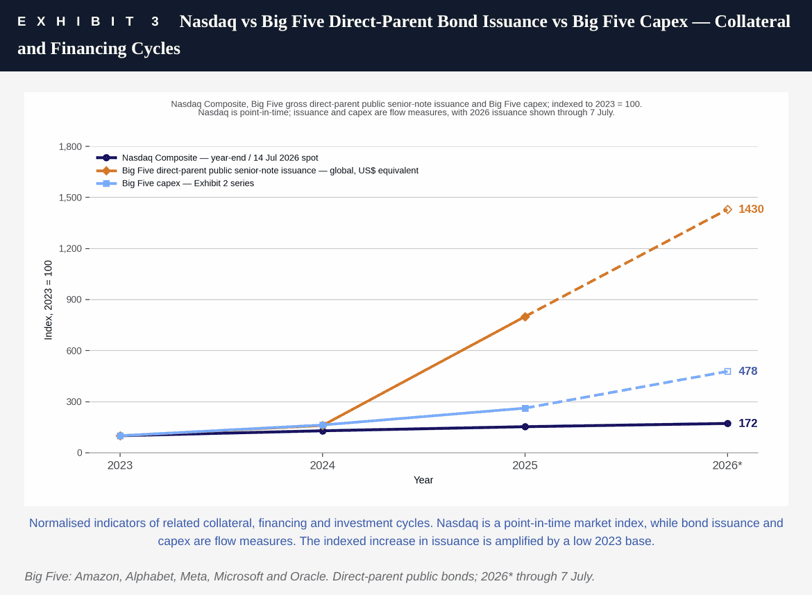
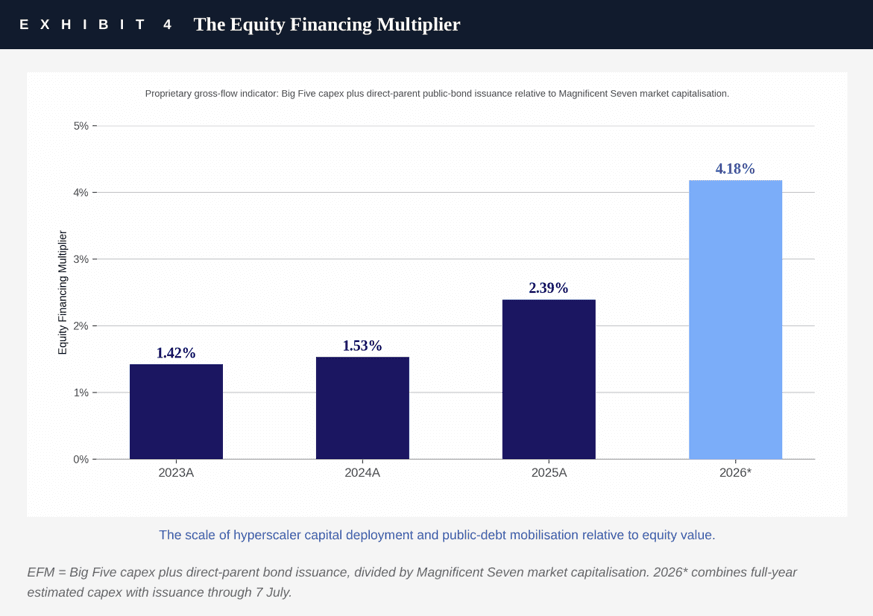
That contract has been torn up, quietly and in stages. Oracle sold $18bn of bonds in September 2025. Meta followed with a $30bn sale that, at the time, tied for the fifth-largest investment-grade corporate offering ever and drew approximately $125bn of orders — the largest U.S. investment-grade corporate order book then recorded — before returning this spring for another $25bn. Alphabet, Amazon, the rest. On the narrower perimeter used in Exhibits 3 and 4, the Big Five issued approximately $108.4bn of direct-parent global public bonds in 2025. A broader $121bn U.S. hyperscaler-linked market-supply estimate includes approximately $27bn of RPLDCI project debt. In January 2026, BofA projected roughly $140bn of annual issuance — close to the Big Six U.S. banks' expected average of $157bn — and raised its 2026 new-debt forecast to $175bn in March. Separately, UBS estimated in February that 2026 hyperscaler public-debt issuance could reach up to $240bn. The technology sector, historically the investment-grade universe's net creditor, could become its largest borrower.
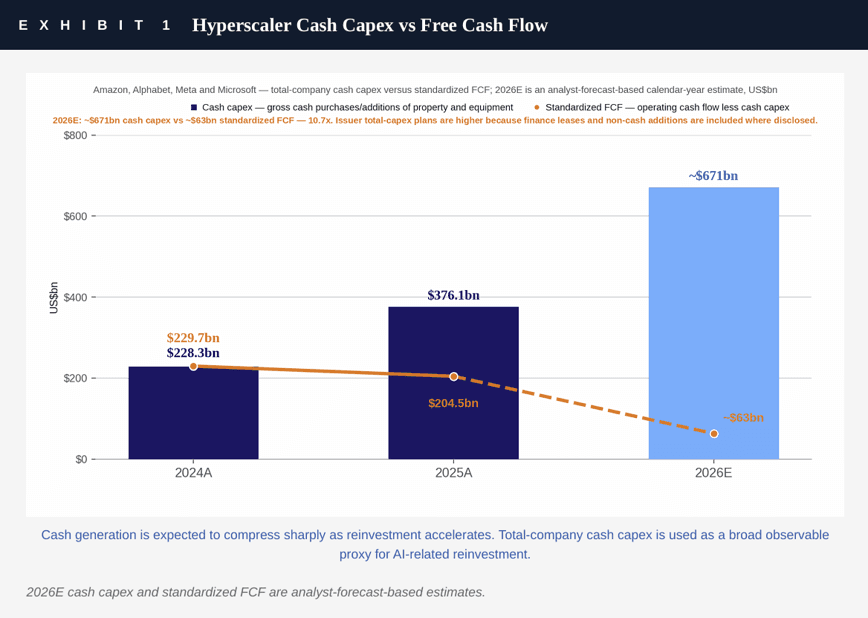
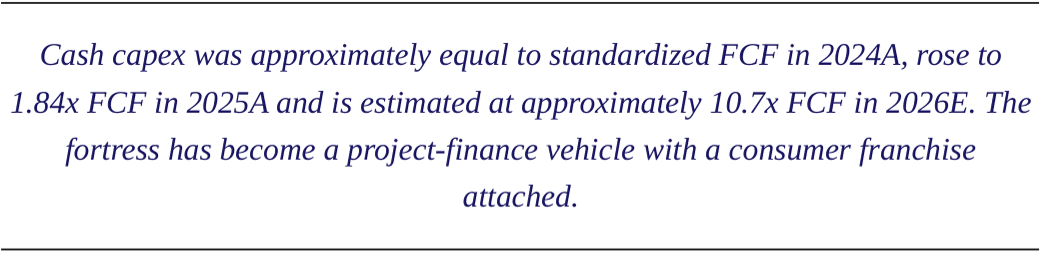
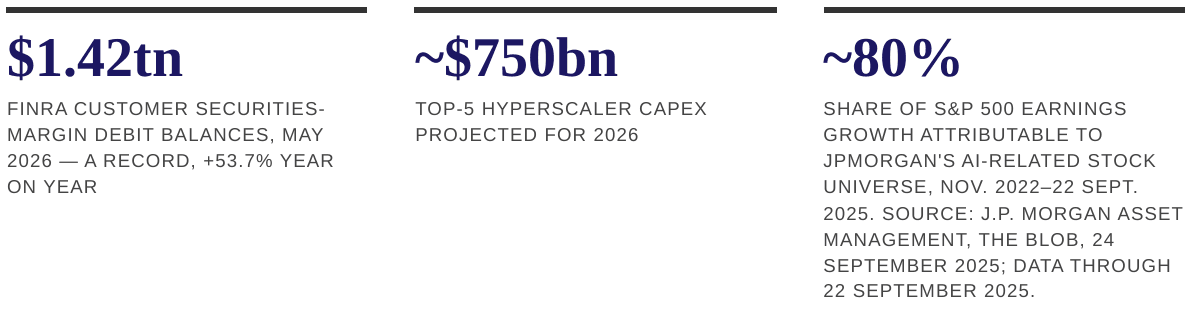
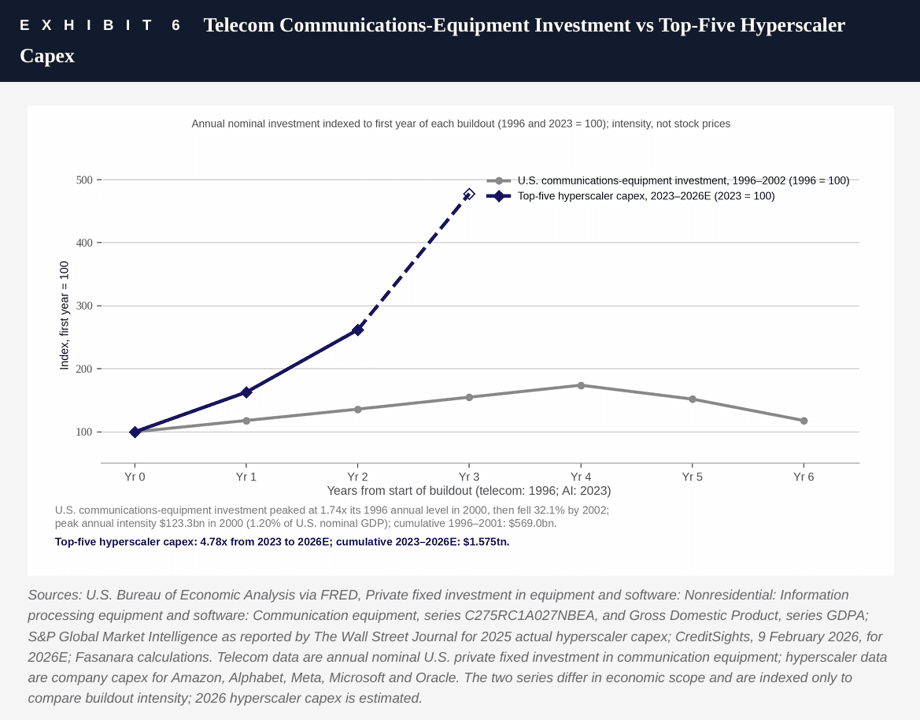
The capex numbers explain why. Top-five hyperscaler capital expenditure is projected around $750bn for 2026, nearly three times the 2024 figure, with some aggregated estimates north of $770bn. As a share of revenue, the ratios have left the realm of the precedented: roughly 86% of sales for Oracle, 54% for Meta, 47% for Microsoft, 46% for Alphabet. On a consistent calendar-year cash basis, combined cash capex at Amazon, Alphabet, Meta and Microsoft rose from $228.3bn in 2024A to $376.1bn in 2025A, while standardized FCF declined from $229.7bn to $204.5bn. A current analyst-forecast-based estimate places 2026E cash capex at approximately $671bn and standardized FCF at approximately $63bn. That would reduce aggregate FCF by roughly 69% year on year and take cash capex to approximately 10.7x FCF. Issuer total-capex plans are higher — approximately $710bn at the midpoint — because their forward definitions include finance-leased and other non-cash equipment where disclosed. The AAA-adjacent fortress has become, in the space of eighteen months, a capital-hungry project-finance vehicle with a consumer franchise attached.
The obvious objection is that these are pristine credits — unsecured bonds, diversified cash flows, gross leverage under a turn, order books of $125bn. All true, and all a statement about the level. The margin-loan frame is a statement about the trajectory: cash capex moving from roughly 1x FCF to roughly 10x in two years, and a funding plan whose continuation assumes the equity story holds. Every margin account is well-collateralised at the top.
The anatomy of a margin loan
A margin loan has three components: an asset pledged as collateral, borrowing extended against that collateral, and a maintenance requirement that forces liquidation when the collateral falls. The lender does not care about the borrower's income; the loan is secured on price. This is precisely the structure the AI complex has assembled — at three nested levels simultaneously.
At the literal level, FINRA customer securities-margin debit balances reached a record $1.42tn in May 2026, up 53.7% year on year and equal to over 4% of annualised nominal GDP.
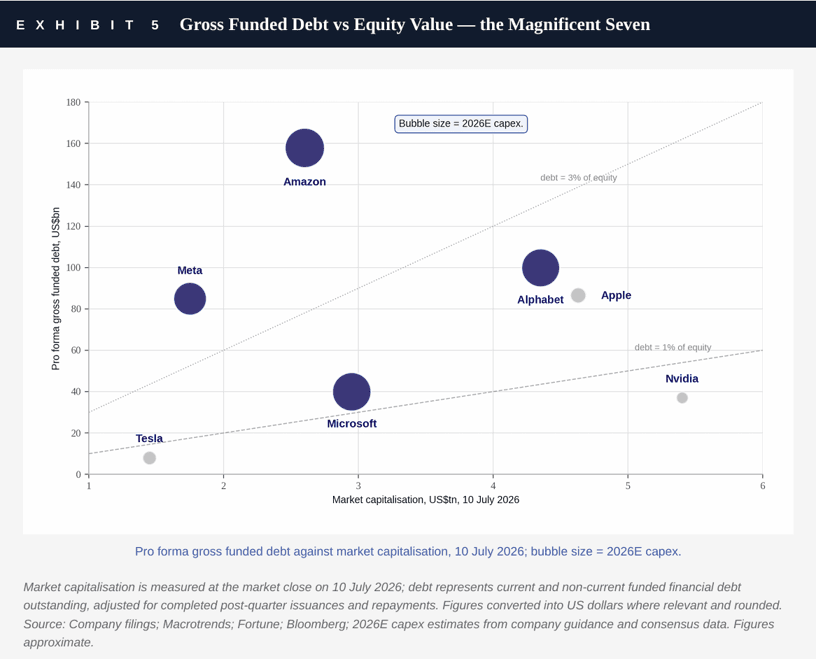
At the corporate level, the borrowing is legally unsecured — but its economics are secured on the equity story. The public bonds are serviced from company-wide cash flows; what increasingly depends on the AI revenue thesis materialising on schedule is the ability to sustain borrowing at this scale and on these terms. Around the edges of the buildout, the metaphor becomes literal: some GPU-backed facilities are secured on chips whose useful lives and residual values are themselves functions of the narrative, while other private-credit, vendor-financing and SPV structures are supported by data-centre assets, leases, capacity contracts or hyperscaler guarantees. The legal collateral differs; the economic bet is the same. And at the systemic level, the S&P 500 itself has become the collateral: the Magnificent Seven represent roughly a third of the index, JPMorgan's AI-related stock universe accounted for approximately 75% of S&P 500 price-return contribution and approximately 80% of earnings growth from November 2022 through 22 September 2025. Household wealth, pension assets, the collateral chains of the funding markets — all now rest on the mark-to-market of a single, synchronised capex trade. The market is not carrying a margin loan. The market is the margin loan.
The problem is not P/E. It is the E.
The consensus debate fixates on the multiple. Is 30x too rich, is 25x defensible, where does this sit against 2000. It is the wrong variable. A P/E ratio is a fraction, and the market has spent three years arguing about the numerator while the denominator quietly changed its nature. The E in today's index is not the E of a mature, diversified profit pool. It is increasingly an E manufactured inside the trade itself.
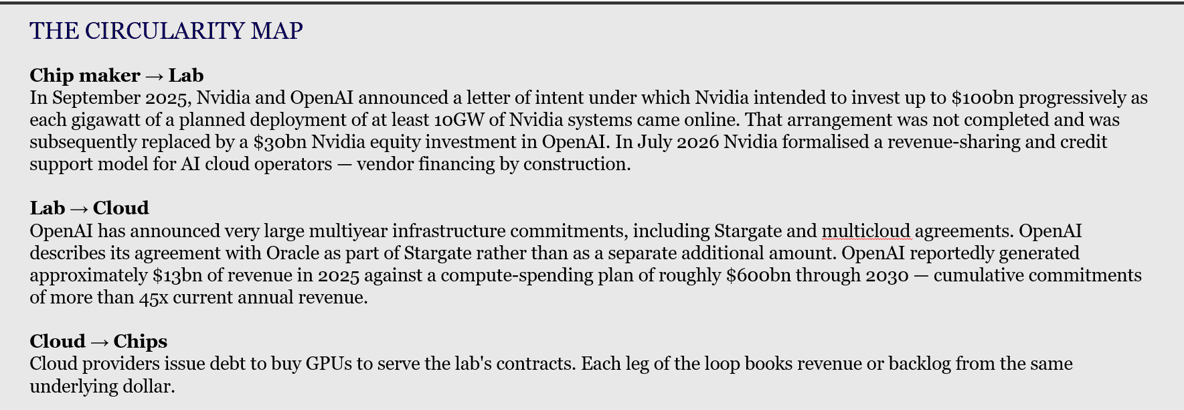
Consider the mechanics. When a chip maker invests in a lab that spends the proceeds on the chip maker's products; when a cloud provider issues bonds to buy GPUs to serve contracts from a customer whose funding the chip maker backstops; when the same dollar of committed spend is booked as backlog by one party, revenue by a second, and growth capex by a third — reported earnings rise, but they rise circularly. Vendor financing does not create demand; it creates the accounting signature of demand. We wrote in these pages that AI is a snake that eats itself on the pricing side — terminal token prices converging towards zero. The financing side is now eating in the same direction: earnings sustained by capital flows that are themselves justified by those earnings.
This is why the P/E debate misses. A 28x multiple on durable earnings is an opinion; a 20x multiple on circular earnings is a leveraged structure. The narrative that propels the E skyward — permanent growth, inevitable adoption, capacity constraints as far as models can see — performs the same function a rising collateral price performs in a margin account. It keeps the loan performing. No covenant is tested while the story compounds. The system is not mispriced so much as mis-described: what is being traded is not a stream of earnings but the credibility of the narrative that generates them.

What a break in the E would trigger
The margin-loan frame matters because it specifies the failure mode. Margin structures do not decay gracefully; they perform perfectly until the collateral test fails, and then they liquidate. If the E disappoints — a hyperscaler guiding down on AI revenue, a lab's monetisation slipping against a reported compute-spending plan of roughly $600bn through 2030, depreciation schedules catching up with three year-old GPUs — the damage does not arrive through the multiple alone. The E falls, the credibility of forward E falls with it, and the multiple compresses on a shrinking base. Price, the collateral, takes the product of both.
Then the mechanics run in reverse, and they run through every layer at once. Falling prices can trigger margin calls in customer accounts carrying approximately $1.42tn of debit balances, creating a potential forced-selling loop. It widens spreads on a technology bond stack that barely existed two years ago, raising the cost of the very issuance the capex plans assume. Meta, Alphabet, Amazon and Oracle rose from 2.2% to 4.1% of the Bloomberg U.S. Corporate Investment Grade Index over the year ended 1 April 2026. The first quarter of 2026 showed how quickly supply pressure moves spreads. It impairs the GPU collateral inside the private financing structures. And it forces the rational corporate response — cut capex — which is itself the E of the ecosystem's suppliers, because JPMorgan estimated that its AI-related stock universe accounted for 90% of S&P 500 capex-and-R&D growth from November 2022 through 22 September 2025. The demand cascade and the collateral cascade are the same cascade. February and March 2026 saw two consecutive monthly declines from a record before balances rebounded in April. The system snapped back. The point is that it had to snap back; a leveraged structure cannot afford to consolidate.
None of this requires the technology to fail. The dot-com analogy is usually deployed lazily, but its precise lesson is the right one: the internet was real, the earnings assumptions financing its buildout were not, and the gap was resolved through the balance sheets of the companies that had borrowed against the narrative. Telecoms carriers were investment grade in 1999. The technology succeeded. The E did not — not on the schedule the leverage demanded. That is the distinction the current consensus flattens when it answers every structural question with 'but the demand is real'. Demand being real and earnings being sustainable on the timetable the financing assumes are different claims. Margin loans do not default because the collateral was worthless. They default because it fell.

Cracks in the funding channel
The funding channel is not waiting for the collateral test to show strain — it is already showing it, in more ways than one. The most visible signs sit in the public market. Amazon's $25bn offering on 7 July was, per Bank of America, the softest hyperscaler bond launch since Meta's $30bn sale in October 2025, and traders have been selling existing tech paper — Amazon, Alphabet, Meta, Oracle among them — to make room for new supply, widening secondary spreads by 7 to 13 basis points; investors are not losing confidence in the sector so much as running out of room for it. The five large hyperscalers issued $159bn of corporate bonds in the first five months of 2026 — more than their total borrowing of the previous five years — and the buyer base is beginning to say so in price.
The less visible signs sit in the structure of the deals themselves, and they are the more telling. As public appetite tightens, the financing is migrating into progressively more complex and less observable channels: off-balance-sheet special purpose vehicles and joint ventures, capitalised by sponsor consortia, raising debt through private placements against long-term leases and capacity offtakes, with the hyperscaler holding a minority stake and providing guarantees — substituting upfront capex with multi-year operating expenses while keeping the associated debt off the balance sheet. The latest expression is the revival of the private bond market — not direct lending, but the century-old placement format in which companies sell securities directly to select institutional investors, above all life insurers hungry for long-dated high-grade paper to match record annuity liabilities. Issuance reached roughly $81bn through May, the highest for the period since records began in 2016, with AI and data centres named as the driver — a channel recently flagged in Bloomberg's Money Stuff. The logic, from the issuer's side, is explicit: this is a hunt for sticky money. Paper sold privately to insurers is held to maturity, unlisted, unmarked and untraded. The financing becomes "secured" for the borrower — locked in, immune to the daily referendum of the secondary market — precisely by becoming unsecured, illiquid and unpriceable for the buyer.
Within the margin-loan frame, this is not a detail; it is the signature. A borrower confident in its collateral does not engineer its lenders' inability to leave. The progression — from cash, to public bonds, to SPVs and leases, to private placements with the stickiest capital in the system — is the funding structure adapting to the possibility that the public market may one day ask questions, by pre-emptively borrowing from investors structurally unable to ask them. Each step lengthens the chain between the asset and its price, moves the leverage further from the covenants, disclosure and daily marks of public credit, and quietly transfers the residual risk to balance sheets — insurance, pensions, annuity holders — that were never meant to warehouse technology-cycle risk. Legislators have begun asking how Big Tech's turn to "complex and opaque debt markets" might transmit destabilising losses to financial institutions; the market, characteristically, is answering the question faster than it is being asked. The cracks in the funding channel are not the widening spreads. The cracks are what the borrowers are doing to avoid ever seeing them.
What to watch
Three gauges, none of them the index level. First, the E itself, in its least manageable form: standardized calendar-year free cash flow at Amazon, Alphabet, Meta and Microsoft, estimated to fall to approximately $63bn in 2026E against cash capex of roughly ten times that figure. Reported earnings can be shaped by depreciation schedules — several hyperscalers have lengthened assumed server lives even as chip cycles shorten — but cash conversion cannot. A widening gap between reported E and delivered cash flow is the earliest honest signal.
Second, the funding channel. Investment-grade technology spreads versus the broad index, the reception of the next jumbo deals, and the migration of the buildout into private credit, leases and SPVs — the places leverage goes when public markets start asking questions. The moment the marginal financing dollar becomes conditional, capex plans stop being announcements and start being negotiations.
Third, the collateral behaviour: the monthly margin-debt series itself; the ratio of margin debt to market capitalisation against its post-2000 extremes; and the correlation between the AI complex and the rest of the index on down days. A margin loan reveals itself not at the top, but on the first test of the maintenance requirement. The data will tell us when the test begins. It will not tell us the outcome — that depends on an E which, for now, remains suspended between the cash flow it delivers and the story that carries it.
This insight follows three pieces that explored similar themes in more detail:
Disclaimer
This material is not intended to be a recommendation or investment advice, does not constitute a solicitation to buy, sell, or hold a security or an investment strategy, and is not provided in a fiduciary capacity. The information provided does not take into account the specific objectives or circumstances of any particular investors or suggest any specific course of action. Investment decisions should be made based on an investor’s objectives and circumstances and in consultation with their financial professionals. The views and opinions expressed are for informational and educational purposes only as of the date of production/writing and may change without notice at any time based on numerous factors, such as market or other conditions, legal and regulatory developments, additional risks and uncertainties and may not come to pass. This material may contain “forward-looking” information that is not purely historical in nature. Such information may include, among other things, projections, forecasts, estimates of market returns, and proposed or expected portfolio composition. Any changes to assumptions that may have been made in preparing this material could have a material impact on the information presented herein by way of example. Past performance does not predict or guarantee future results. Investing involves risk; principal loss is possible. All information has been obtained from sources believed to be reliable, but its accuracy is not guaranteed. There is no representation or warranty as to the current accuracy, reliability or completeness of, nor liability for, decisions based on such information and it should not be relied on as such. Fasanara Capital Ltd, is authorised and regulated by the Financial Conduct Authority (“FCA”).
Important information on risk
Investing involves risk. The value of any investment and the income from such can go down as well as up, and you may not get back the full amount invested. Changes in the rate of exchange may also cause the value of overseas investments to go up or down. This information represents the views of Fasanara Capital Ltd and its investment specialists. It is not intended to be a forecast of future events and/or guarantee of any future result. Information was obtained from third party sources which we believe to be reliable but are not guaranteed as to their accuracy or completeness. There is no assurance that an investment will provide positive performance over any period of time. This information does not constitute investment research as defined under MiFID.